
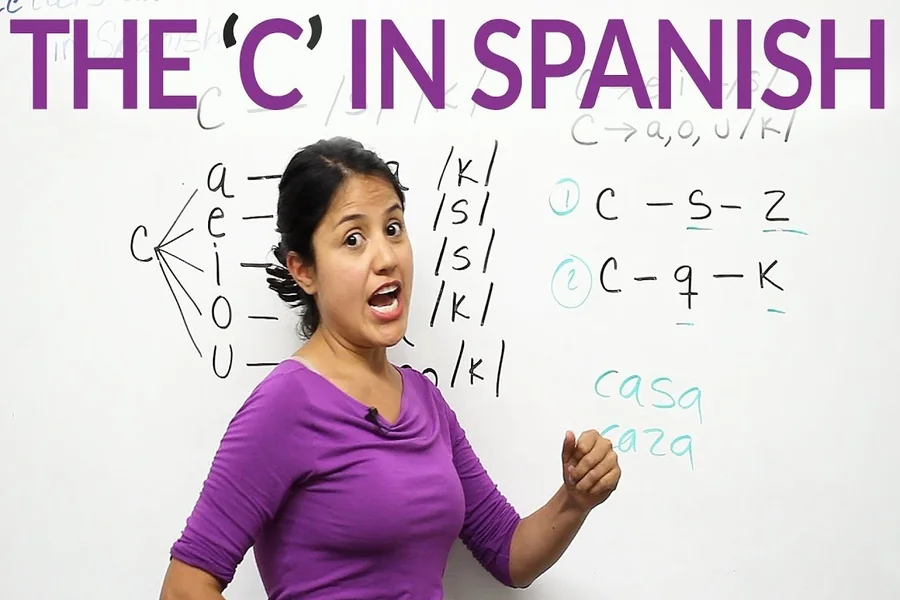
Spanish words that start with C appear early and often in everyday speech, like casa, comida, ciudad, and cultura. Because the letter has more than one sound and there are some very clear rules of spelling they can help you learn faster, or it can make you confused. Focus helps in preventing you from guessing. Instead of learning words in and of themselves, consider the pronunciations, spellings and usage of words. When you see those links, you are able to learn new words easier, you would be able to remember the words and use them correctly in real conversations and writing.
Two core sounds
Most of the confusion arises from the sound, as C maps to two main pronunciations. In many situations it is a hard /k/, as in cama or comprar (this is especially true in the case of a, o, u and a consonant. Before the letter e or i, it is shifted, pronouncing like an s in much of the Americas and pronounced like a th in much of Spain. This regional splitting is not problematic for understanding, but must alter the expectation for listening. With Spanish words that start with C, train your ear on both patterns. Recording helps you to listen for consistency across syllables.
Spelling with ce ci
Spelling is easier if it is linked to the vowel that comes after it. The combinations ce and ci are probably the more stressful when they indicate the softer sound, so in a certain sense words such as cena, cielo and cifra are predictable once you get the hang of the pattern. The practical limit is of most learners over-generating and writing se or si under the presumption that the sound corresponds to their linguistic dialect. In formal writing, such a short-cut is expensive. When working with Spanish words that start with C, practice minimal pairs such as cera versus sera to sharpen attention. Dictations make you commit spelt how you have to.
When to choose qu
The letter C cannot always tolerate the /k/ sound before e or i without confusion, so Spanish uses qu in many common families. That is why you write que and qui and words like queso, or quitar instead of ceso or citar when you mean /k/. This is a tradeoff between qu preserves the sound consistency, and qu adds some silent u which is forgotten by the learners. When studying Spanish words that start with C, notice that many high-frequency forms begin with co or ca, while the /k/ plus e or i often shifts to qu.
High-utility nouns
If your goal is communication on a daily basis, focus on the nouns associated with places, objects and relationships since they are cross topic. Words like casa, calle, comida, and cuenta slotted themselves into such words as errands, travel, and small talk without the need for some fancy grammar. The limitation is that many nouns have similar shapes, and because there is no context with memorization, it brings out swaps similar to the confusion between copa and capa. In order to avoid that, assign a concrete scene to each noun gone in one sentence with a. verb, e.g. “cerre la cuenta” at a cafe, “cruce la calle” near a bus stop. Context prevents the meaning from being unstable.
Verbs for conversation
Verbs starting with C are strong because those are the ones that are used to drive actions as well as ask nice people for things. Comer, contar, cambiar and buscar are common but the big pay off would be to learn the most common forms such as como, wanting to change, or can you count me? The tradeoff is time: drilling full paradigms can stall out speaking confidence. Instead, learn three high leverage tenses. Then attach these tenses to re-occurring situations. Such as ordering food, problems, etc. As you expand Spanish words that start with C, treat each new verb as a reusable sentence frame, not an isolated item.
Adjectives with nuance
Adjectives that start with C, etc., how to evaluate ideas and still be polite, how to speak politely in school and at work. Calmo, claro, correcto, and complejo allow to qualify people and plans with accuracy. The and constraint is register; invoking a proposal complejo may be neutral in an academic context and discouraging in more casual conversation (most likely as long as you don’t give context for the call. Practice combining the adjective with a reason clause, for example, es complejo porque falta informacion. When adding Spanish words that start with C, watch how the adjective shifts the social tone of your sentence for your listener.
Cognates and traps
Cognates can speed up learning, but only if you are willing to see similarity as a guess, not a fact. Many C words are close to English words, such as cultura and central, which means less time decoding required when reading. Others mislead: carpeta is folder, not carpet, and collège doesn’t mean university, usually it means school. These mismatches are important because they produce overconfident error which is difficult to detect when conversing. A practical check is to search out the word in a Spanish sentence and see what object, or institution, it usually calls in context before speaking.
Academic and work terms
Professional Spanish often lends itself to Latin-based words and many of these words begin with the letter C. Concepto, condicion, convenio and criterio are used for reports and meetings, where precision is important. The tradeoff is cognitive load: these things are abstractible things-so flashcards aren’t enough for them to stick in your head. Anchor each of the terms to a tangible decision such as making a condicion to be asked for approval; or making a criterio for selecting suppliers. When building Spanish words that start with C, prioritize collocations you will say, like “segun el criterio” or “bajo esta condicion,” and recycle them across emails every week.
Practice without rote
The recall need to be balanced with encouraging relevant feedback, for C spelling errors have a different way of fossilizing when you are only passively a reader. Do speaking tasks that require retrieval usingłu, such as telling the way by using ciudad, coche or camino, and check the spelling afterwards. Next, write the two sentences and correct for register, using either claro or complicado based on intent. The tradeoff is slower progression in word counts. But accuracy is compounded. A cycle of speaking, writing, and correction outperforms cramming for Spanish words that start with C. Because it connects sound and orthography under pressure consistently.
Final Thought
Learning Spanish words that start with C is less about memorizing long lists. It is more about recognizing patterns that connect sound, spelling, and context. When you know the difference is that casa is pronounced differently from cielo, or queso is spelled with qu, vocabulary stops being arbitrary. The most permanent progress is in the usage of these words in meaningful situations, in perfecting the form of pronouciation, and in spelling with intention. As time goes on, C will no longer be a letter that you just learn but will be a predictable system where you yourself will be able to trust in using it in real communication.
FAQ
How do I pronounce ce and ci?
Match the sound to the vowel: ce and ci usually take the softer value, varying by region, so listen widely.
Is C always pronounced like k?
No. It is commonly /k/ before a, o, u, but it often softens before e and i.
Which C words help beginners most?
Start with Spanish words that start with C that you can place in daily scenes, then reuse them in short sentences.
Why does Spanish use qu often?
Qu keeps a /k/ sound before e or i, even though the u is silent, so spelling stays predictable.
How can I improve spelling accuracy?
Write, then correct: short dictations and one focused revision pass build durable habits faster than rereading alone.