
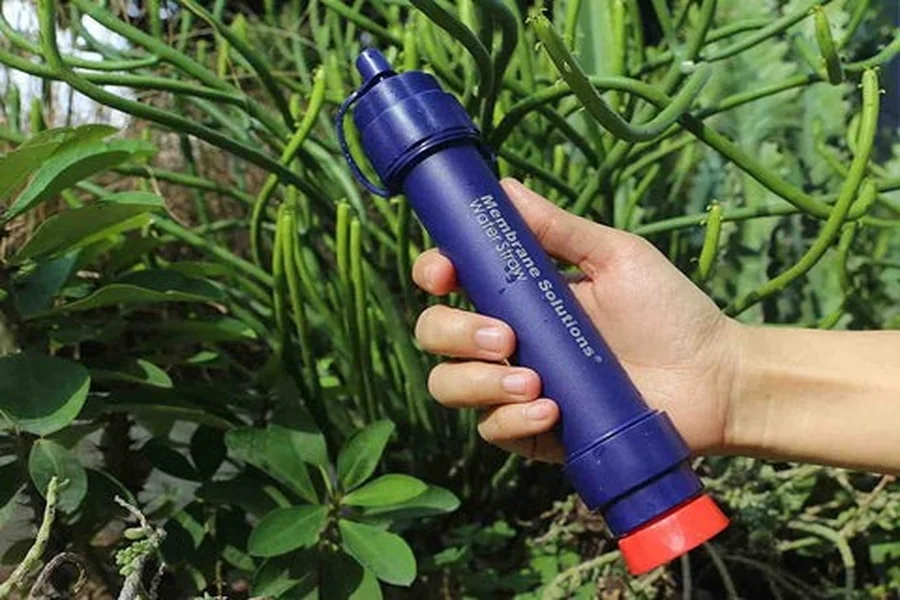
When choosing between the straw filters it is less of a brand decision and more of a risk matching to constraint. In Membrane solutions straw water filter vs lifestraw, both aim to make questionable freshwater safer when you cannot carry enough treated water. The key is what your likely sources are, your maintenance tolerance and whether taste improvement is as important as pathogen reduction. A straw is not a universal purifier and the more intelligent comparison is to ask what the design prioritizes and what you need to add around to be safe. That frame has the advantage of avoiding surprises on trips.
What straws remove
Most straw filters are based on hollow-fiber membranes which are physically straining the massive microbiology and debris. For water used for typical hiking, that translates into high protection against bacteria and protozoan cysts, provided it is used properly and remains undamaged. In Membrane solutions straw water filter vs lifestraw, the shared principle is simple: particles larger than the membrane pores stay behind, while clearer water passes through under suction. This is best used in moving streams and lakes with limited organic sludge, since fewer solids reach the fibers. Some microplastics can be reduced through it. The performance of them is depending on tight seals.
What straws miss
A straw microfilter does not aim to solve all water problems, and it is this which is the source of many disappointments. Dissolved salts, most metals and many agricultural or industrial chemicals travel in the water molecules, so they go right through membranes unless there is a special adsorber stage and it is sized accordingly. Viruses also are smaller than the pores in the majority of straw filters so that viral risk demands additional steps such as chemical disinfection, UV treatment, or heat. Context determines whether that is the case. In areas of flooding or cramped camps, make this higher viral and chemical uncertainty assumptions for the most part.
Taste and carbon
Taste is not superficial though because unpleasant water provokes underhydration, risky shortcuts. Some straw designs combine microfiltration with activated carbon to remove chlorine-like odors, tannins, and other organic compounds that affect flavor. Although carbon has a finite capacity and is not a guarantee against all toxins. In Membrane solutions straw water filter vs lifestraw, check whether the exact model you are considering includes a carbon stage, whether it is replaceable, and whether flow remains comfortable as it loads. If taste is important don’t plan to put spares of these on, or accept shifting down in the service life sooner.
Flow and effort
Flow rate is at the same time engineering and partly physiology. One straw easy for one person can be tiring for another after a long climb, due to increased suction work when pores become fouled or when the intake is at the level of silty water. Ergonomics are also important: a wider mouth piece will give lower jaw fatigue while a better grip is an advantage when you have cold or wet hands. If you anticipate filling bottles rather than sipping from the bottom, look for adapters that minimize solution loss and let you keep the intake off the bottom. These kinds of details determine field use.
Clogging and lifespan
Published life-span numbers can be misleading, because they assume that water is relatively clean, and these numbers assume that the water is not mishandled. The practical limiter is clogging: fine silt and algae form a cake on the abuse membrane with increasing resistance until drinking is frustrating. In Membrane solutions straw water filter vs lifestraw, treat any advertised capacity as an upper bound, then adjust for your environment. Glacial melt, desert potholes, and storm runoff will cut short usable life in no time. Pre filter of cloth and avoiding bottom sediments often is more important than brand. So does rotating sources to springs when possible, to cleaner sources.
Cleaning and safety
Maintenance-is where safety quietly fails. Because you suck through the same mouthpiece many times, cross-contamination can visit hands, and then lips, unless you put caps on the ends, and keep the intake away from dirty surfaces. Many straw filters can be cleaned by blowing back or flushing with clean water, but backflow can also spread the contamination if you do it over a shared water container. Build a routine – External rinse, storing dry when you have the chance and using the straw as food contact equipment and not just as equipment. The people should then, in groups, assign each person one straw.
Durability in packs
Durability is about more than plastic toughness, however, it is also about what is happening inside the fibres. If a housing that contains a hollow fiber element freezes wet, expansion may cause channels to be ruptured and bypass paths to be created which are difficult to detect. That is why winter users should also keep the filter as close to the body as possible during the day and inside a sleeping bag at night. Rough traveling also puts stress on caps and seals so a protective bag is helpful. For emergency kits going into a storage for years, stability of materials and clear directions on storage style should take a back seat. And replace part with cracked parts immediately.
Evidence and labels
Marketing terms, such as purifier and survival are not more informative than test conditions. In Membrane solutions straw water filter vs lifestraw, the most useful documents are third-party lab summaries that state what organisms were tested, at what concentrations, and how performance changed over the filter’s life. Certifications can help, but only if the scope is appropriate to your concerns, such as microbiological reduction versus taste and odor. With vague documentation, take that to mean they are uncertain, and combine Straw and publication of a second disinfection method. For travel, local water advisories can be used to determine that.
Best-fit scenarios
Which one you choose depends on whether you’re short of convenience or robustness. If you are just going for a backup for day-hikes then either straw can work when one also carries a small chemical disinfectant for high risk situations. If you are creating a household emergency bin, think of some ways that members of your family easily use it, how you will store it, and what water sources you have access to realistically. Membrane solutions straw water filter vs lifestraw becomes clearer when you map the whole system: containers, prefiltering, disinfection, and training. Not just the straw.
Final Thought
A fair reading of Membrane solutions straw water filter vs lifestraw shows that neither product is inherently superior in every context. Because both rely on similar hollow-fiber microfiltration and share comparable strengths and limits. The meaningful difference is through the way you are going to use it. If you expect silty sources, rarer maintenance or freezing temperatures, durability and care routine are more relevant than brander statements. If taste and the convenience of daily life are most important, carbon frames and ergonomics are worth considering. The most responsible thing to do is to pair either straw and back with back disinfection and realistic expectation issues.
FAQ
Do these straws make tap water safe?
Membrane solutions straw water filter vs lifestraw targets questionable freshwater; for metals or pesticides in tap water, choose adsorption or reverse osmosis.
Can either straw handle viruses?
Straw microfilters target bacteria and protozoa. Where viruses are plausible, add chemicals, UV, or boiling.
How should I store a straw filter?
After Membrane solutions straw water filter vs lifestraw use, drain it, cap it, avoid freezing, and dry it to limit biofilm.
Is cloudy water a deal breaker?
Cloudiness increases clogging and suction; prefilter with clean cloth and let sediment settle first.
Which is better for emergency kits?
Membrane solutions straw water filter vs lifestraw depends on training and redundancy; pick what your household can use and pair it with clean containers plus backup disinfection.